
The Story Behind Pallada
From a set of custom indicators in 2004 to a complete directional trading framework — built by traders, for traders.
Where It All Started
TradeWays was founded by a group of professional traders and software developers who shared a common frustration: most retail trading tools were either overly simplistic indicators or opaque black-box robots that promised everything and delivered nothing.
The team set out to build something different — a trading system based on real market mechanics: trend structure, range breakouts, momentum confirmation, and key price levels. The result was Pallada, a visually intuitive set of indicators with clearly defined rules for manual entry.
Pallada quickly gained traction in the English-speaking trading community. Over the following years, more than a thousand copies were sold to traders across the globe — from the US and UK to Australia, Japan, and the Middle East.
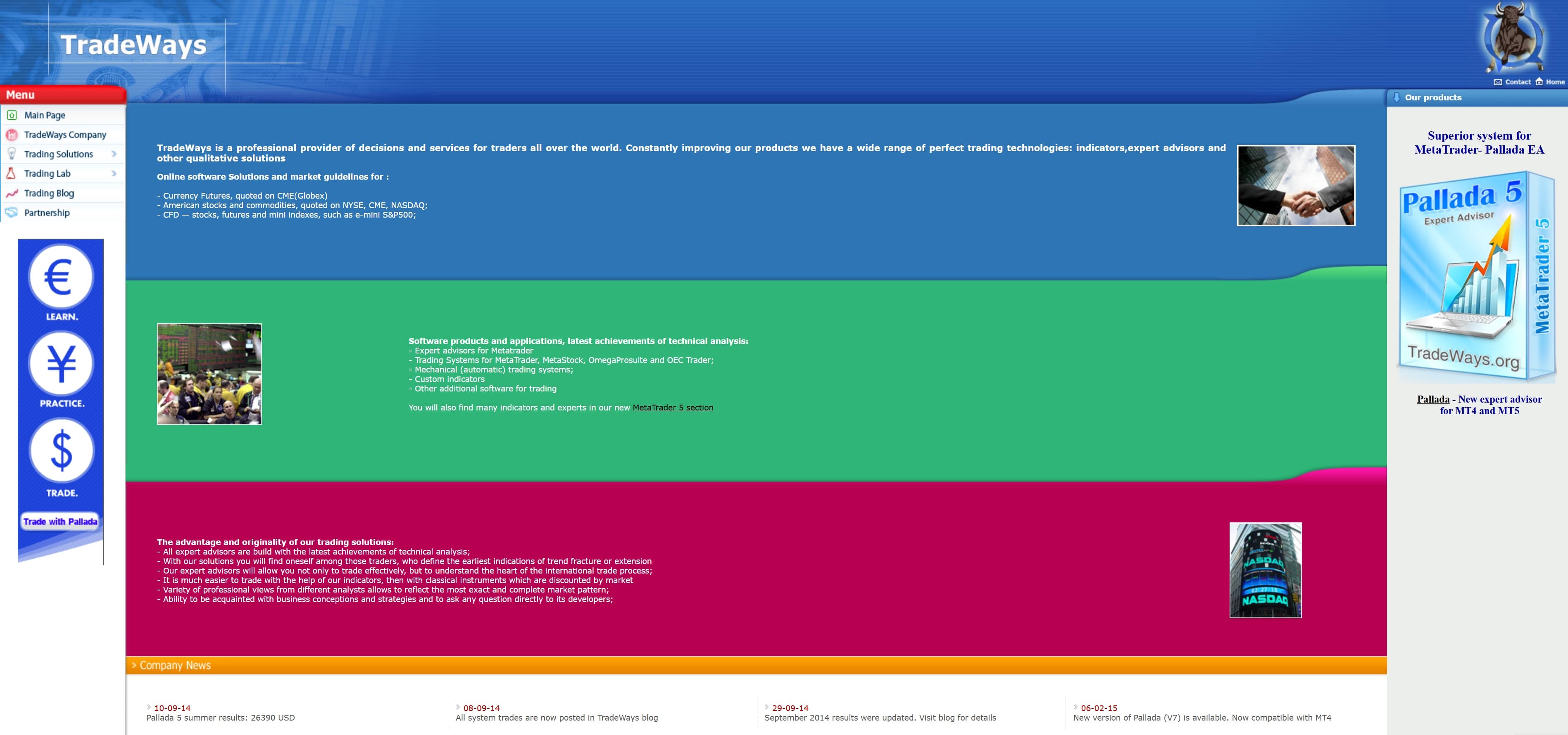
The original TradeWays.org website — where it all began
Years of Refinement
The original Pallada was a manual system — traders entered positions based on indicator signals (arrows), and an expert advisor managed the open trades. It worked, but it had limitations: the entry decision depended entirely on the trader's discipline and experience.
Over the next decade, the team experimented with full automation. A fully automatic expert advisor was developed and tested extensively. The honest conclusion: pure automation couldn't replicate the quality of human-filtered entries. The best results came from combining systematic analysis with discretionary filtering.
This insight became the foundation of the new Pallada — a system where indicators identify raw setups, strict rules filter the valid ones, and the trader (or an automated follower) executes only the qualified trades.
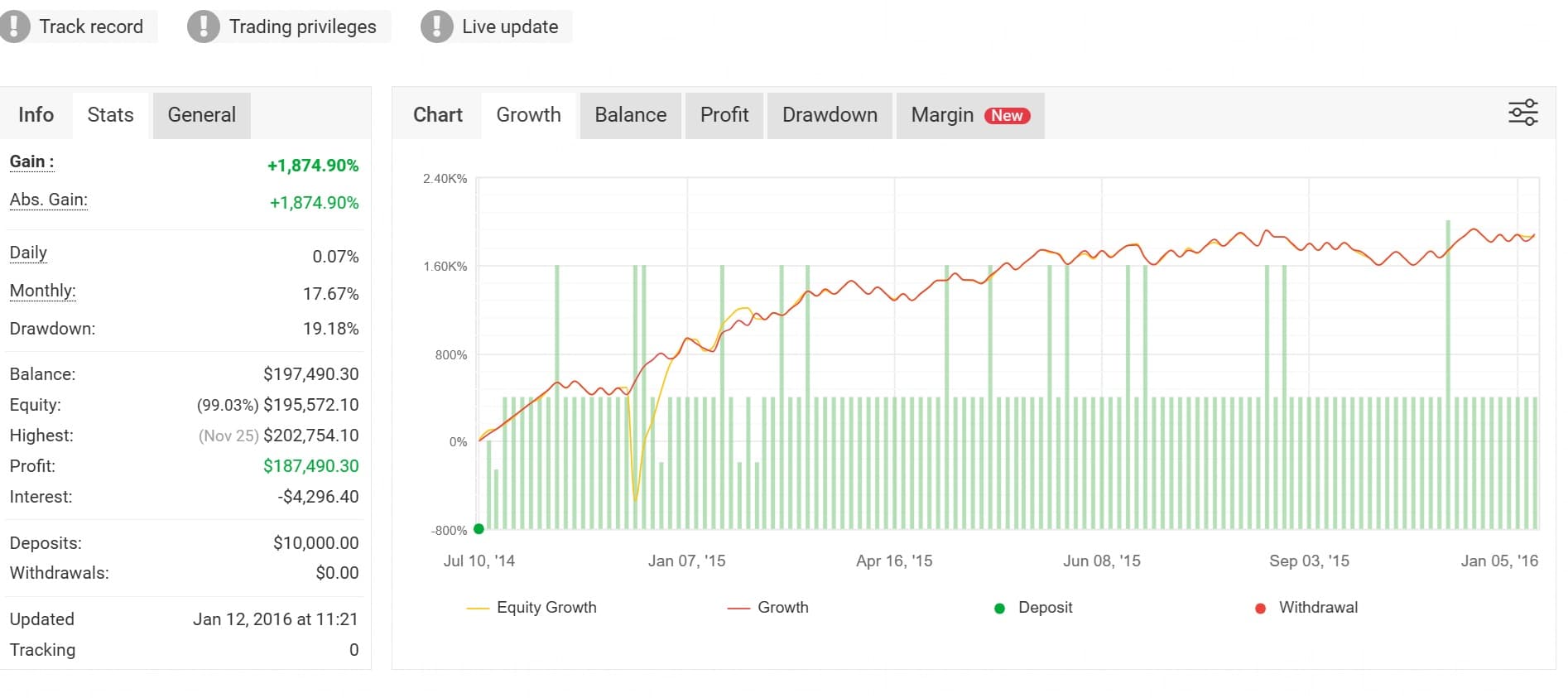
Historical verified results on Myfxbook (2014–2016): +1,874% gain, 19.18% max drawdown. Past performance does not guarantee future results.
Pallada Reborn
The new Pallada is not just an indicator set. It is a complete directional trading framework that combines:
- Multi-layer trend detection (moving averages, daily levels, range analysis)
- Signal filtering based on momentum, crowd positioning, and structural confirmation
- Three usage modes: Analyze, Select, or AutoFollow
- Real-time alerts via Telegram with chart screenshots
- Web dashboard with directional bias and signal history
- Automated execution on supported pairs (GBPJPY, EURJPY, EURUSD)
The core philosophy remains the same: not every arrow is a trade. The value is in the filtering, not in the signal count.
Why AI Alone Can't Trade the Markets
Every year a new wave of “AI trading bots” promises to replace human traders. After 20 years of building and testing automated systems, here is what we've learned:
Markets are not a static dataset
AI models are trained on historical data and assume the future will resemble the past. But markets evolve — correlations break, regimes shift, and patterns that worked for five years can stop overnight.
Context matters more than pattern recognition
A central bank surprise, a geopolitical event, or a sudden liquidity vacuum changes everything. AI sees numbers; a trader understands why those numbers are moving.
Black-box models can't explain their decisions
When an AI enters a trade, it can't tell you why. You can't evaluate the risk, you can't adjust it, and you can't learn from it. You're forced to blindly trust a model that may be overfitting to noise.
Even the best funds keep humans in control
Renaissance Technologies, Two Sigma, Citadel — the most successful quantitative funds in the world employ hundreds of researchers and traders to oversee, adjust, and veto their algorithms.
Our approach: let the algorithm scan the market and identify setups. Let a human with decades of experience decide which ones are worth trading. The best of both worlds.
What We Believe
Direction over noise
95% of retail traders lose because they trade against the dominant trend on tiny timeframes. We focus on identifying the big picture first.
Filtering over frequency
More signals does not mean more profit. We deliberately filter out weak setups so that only high-probability trades reach execution.
Transparency over promises
We show our methodology, publish trade breakdowns, and never promise guaranteed returns. Trading involves risk. Drawdowns happen.
Choice over lock-in
Use Pallada as a trend compass for your own strategy, pick signals manually, or enable full automation. The system adapts to you, not the other way around.